North Carolina Car Loan Laws
North Carolina caps dealer finance rates by the age of the car, makes dealers post their doc fee, and lets a lender repossess without a warning period once you default.
Updated By Lenditia Editorial Team 6-minute read No right to cure
In short
North Carolina's Retail Installment Sales Act caps the rate on a dealer-arranged car contract at 21% for newer vehicles when you finance $3,000 or more, rising to 26% and 30% for older ones. Dealers may set their own doc fee, but they must post it on a sign, include it in advertised prices and list it on the buyer's order. Instead of sales tax, you pay a 3% highway use tax on the price minus your trade-in. There is no right to cure before repossession. The Office of the Commissioner of Banks licenses consumer finance lenders.
- Right to cure
- None in state law
- Rate ceiling
- 21% to 30% by age
- Doc fee limit
- No cap; must be posted
- Vehicle sales tax
- 3% highway use tax
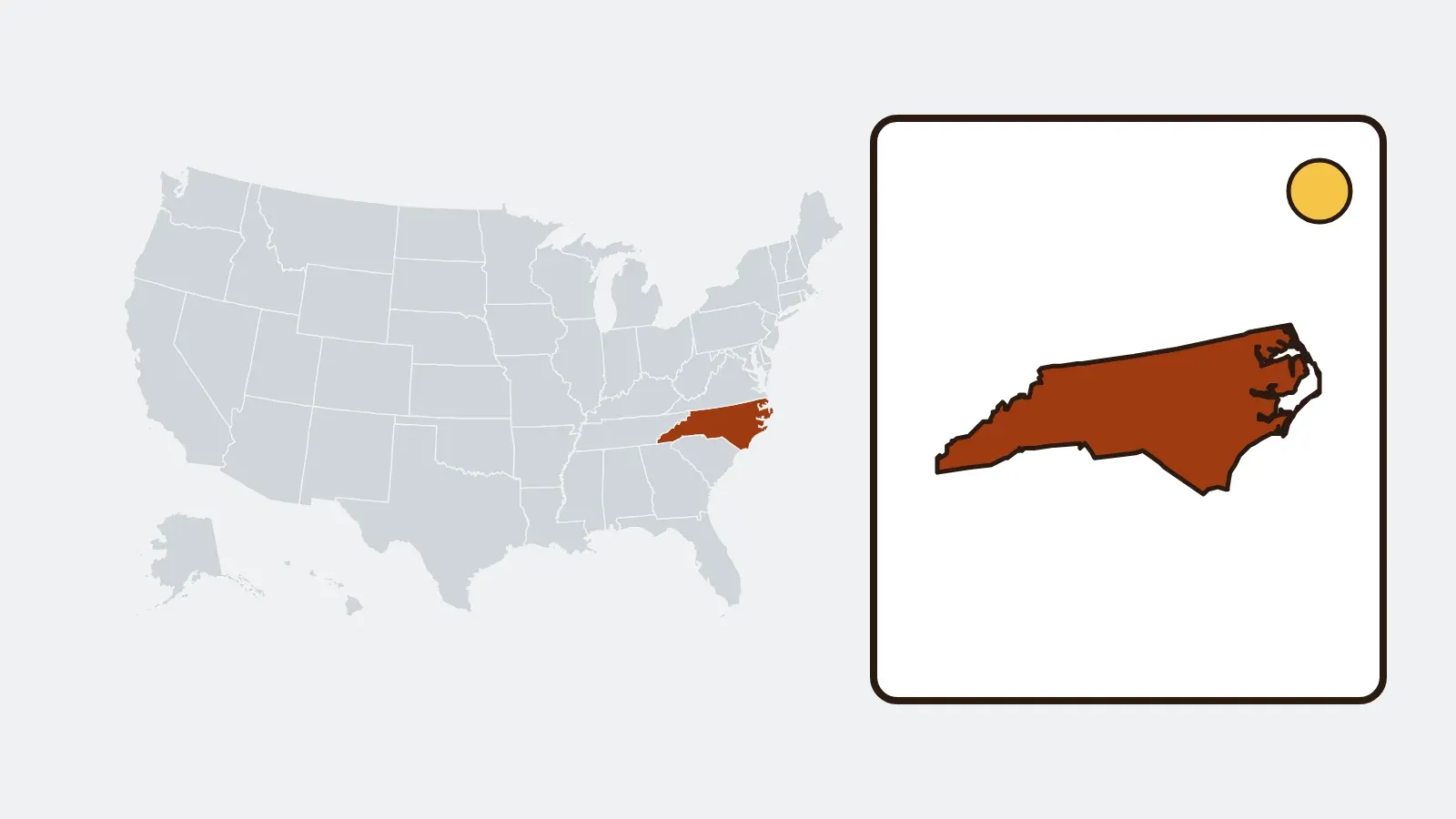
North Carolina car-finance rules at a glance
- Right to cure
- None; repossession may follow any default
- Rate ceiling
- 21% (24% under $3,000) on newer cars; 26% at 4-5 years; 30% older
- G.S. 25A-15, tiers in force since October 1, 2023; banks and credit unions follow their own rules.
- Doc fee limit
- No cap; amount must be posted, advertised and itemized
- G.S. 20-101.1 requires a sign at least 24 inches on each side.
- After repossession
- Notice before sale; you may redeem; deficiency allowed
- Vehicle sales tax
- 3% highway use tax on the price minus trade-in
- Regulator
- North Carolina Office of the Commissioner of Banks
How much interest a North Carolina car contract can carry
Chapter 25A of the General Statutes covers the retail installment contract you sign when a dealer arranges the loan. G.S. 25A-15 sets a general cap of 21% a year when the amount financed is $3,000 or more, and 24% when it is less. For a car paid in six or more installments, the dealer may instead use a higher rate based on the vehicle's age.
| Vehicle age | Model years in 2026 | Maximum rate |
|---|---|---|
| Current model year | 2026 and newer | 21% (24% under $3,000) |
| 1 to 3 model years old | 2023 to 2025 | 21% (24% under $3,000) |
| 4 to 5 model years old | 2021 and 2022 | 26% |
| 6 or more model years old | 2020 and older | 30% |
A vehicle turns one model year old on January 1 of the year after its model year. The 20% age-based tier for one- to three-year-old cars is lower than the 21% general cap, so the general cap applies. To see what a ceiling costs: $20,000 over 60 months at 21% is $541.07 a month, about $12,464 in interest; at 30% it is $647.07, about $18,824. Most buyers with good credit pay far less, so run your own numbers in the car payment calculator.
If a payment is 10 or more days late, the contract may add a flat $18 default charge, once per late installment (G.S. 25A-29).
Doc fees and the highway use tax
- Doc fee. No law sets a dollar limit. Under G.S. 20-101.1 a dealer that charges an administrative or documentary fee must post a sign at least 24 inches on each side in the sales or finance area stating the amount.
- Advertising. Advertised vehicle prices must disclose the fee and its amount, and the buyer's order must show it as a separate line.
- Highway use tax. North Carolina charges 3% of the vehicle's price, collected when the title is issued. On a dealer sale, the trade-in allowance comes off the price first (G.S. 105-187.3).
- Doc fee is taxed. The 3% applies to the doc fee too. A service contract listed separately is not taxed.
What happens if you fall behind in North Carolina
North Carolina has no statute that gives car buyers a notice and a set period to catch up. G.S. 25A-19 allows acceleration or repossession only for a breach of a promise or condition clearly stated in the contract, such as missed payments. After that, the lender may repossess without going to court as long as it does not breach the peace.
- Notice before the sale. The lender must send a notice describing the sale, any deficiency you may owe, and a phone number for the amount needed to redeem (G.S. 25-9-614).
- Redemption. Until the sale, you can get the car back by paying the full amount owed, including the lender's expenses.
- Rebate of unearned charges. The finance charge is rebated as if you paid in full on the earlier of a judgment or 15 days after repossession (G.S. 25A-32).
- The deficiency. If the sale brings less than the balance, you owe the difference, and you may ask for a written explanation of how it was figured.
Our guides to repossession and the balance left after a sale show what to check at each step.
Where to check a lender and complain
The Office of the Commissioner of Banks licenses consumer finance lenders under the Consumer Finance Act and handles complaints about state-licensed lenders. Banks and credit unions answer to their own regulators. Payday and title-loan rules are on Lendmira's North Carolina page.
Commissioner of Banks
Licenses consumer finance lenders and takes inquiries and complaints about state-licensed lenders.
North Carolina Attorney General
Its consumer protection staff take complaints about dealer sales and advertising practices.
Consumer Financial Protection Bureau
Takes complaints about any auto lender or servicer, including banks and finance companies.
Questions people ask
What is the maximum interest rate on a car loan in North Carolina?
For dealer-arranged contracts, 21% a year on newer vehicles when you finance $3,000 or more, 26% on vehicles four to five model years old, and 30% on vehicles six or more model years old.
How much can a North Carolina dealer charge for a doc fee?
There is no dollar cap, but the dealer must post the amount on a sign, disclose it in advertised prices and list it separately on the buyer's order.
Do I pay sales tax on a car in North Carolina?
You pay a 3% highway use tax instead, on the price minus your trade-in. The doc fee is included in the taxed amount.
Do I get a warning before my car is repossessed in North Carolina?
Not by law. The lender can repossess after a default without advance notice, but it must notify you before the sale. See what to do when you fall behind.
Sources
- G.S. 25A-15: Finance charge rates, including motor vehicle tiers (amended by S.L. 2023-60)
- G.S. Chapter 25A: Retail Installment Sales Act
- G.S. 20-101.1: Dealer administrative and documentary fee disclosure
- G.S. 105-187.3: Highway use tax rate and base
- G.S. 25-9-614: Notification before disposition in consumer-goods transactions
- North Carolina Office of the Commissioner of Banks: Consumer inquiries and complaints
Facts on this page were checked against these sources on October 26, 2026. The current motor vehicle rate tiers apply to contracts made on or after October 1, 2023.
Read next
-
Guide
Retail installment contract
The disclosure box, the Holder Rule notice, spot delivery and arbitration clauses, and a signing checklist.
-
Help
Repossession
When the lender can take the car, what an agent may not do, and how to get it back.
-
Guide
Out-the-door price
Every line from vehicle price to amount financed: doc fees, sales tax, add-ons and the trade-in.